Motherly Love and Chosen Kinship
The Most Precious of CargoesMotherly Love and Chosen Kinship describes a family formed not by blood alone but by the choices and labor through which people sustain a child. The Poor Woodcutter’s Wife longs for a child before the train delivers one into her arms; she then claims the hungry infant as her own, even when her husband rejects the child. As survival requires help beyond the household, motherhood becomes a shared practice of feeding, sheltering, and relinquishing control. The child’s birth father eventually finds her alive, but chooses not to reveal himself, leaving the family built through care undisturbed.
Longing and the Meaning of Motherhood
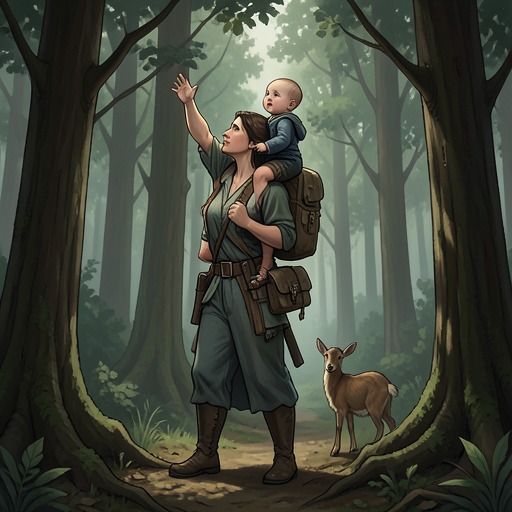
The Poor Woodcutter and Poor Woodcutter’s Wife have no children. He gives thanks for this, seeing it as one less mouth to feed; she grieves in secret because having no child also means having no child to love. Her longing is not abstract: she appeals to heaven and to the natural powers around her, praying for a child as she walks through the woodland to provide for their family while the Poor Woodcutter is conscripted for public works. Their opposing responses establish that parenthood has different meanings within the same marriage. For him, a child would deepen material hardship; for her, the absence of a child is an emotional deprivation.
The story places this desire beside the danger facing Jewish families under persecution. In the spring of 1942, Dinah considered whether to end her pregnancy, not yet knowing she carried twins. She decided to keep them. After their birth, the children were already registered and marked as targets, while Dinah’s milk and hope seemed to promise that they might nevertheless grow up. Her husband had tried to protect them, pestering the camp administration on their behalf. But aboard the deportation train, with Dinah’s milk dried up and the family’s future becoming clear, his efforts could no longer secure their safety. The contrast is stark: one household fears an additional child as a burden, while another has children it desperately wants to save but cannot protect.
A Child Claimed and Protected
When the train’s hand drops a small package into the snow near the Poor Woodcutter’s Wife, she understands the gesture as a delivery meant for her. Inside is a living, starving baby, not the serene, grateful infant of a sacred image. The child struggles and cries, and the woman’s first experience of motherhood is therefore inseparable from an urgent practical question: how to feed a baby when she has no milk. She wraps the child in her scarves and carries the infant home, feeling at once fulfilled and overwhelmed.
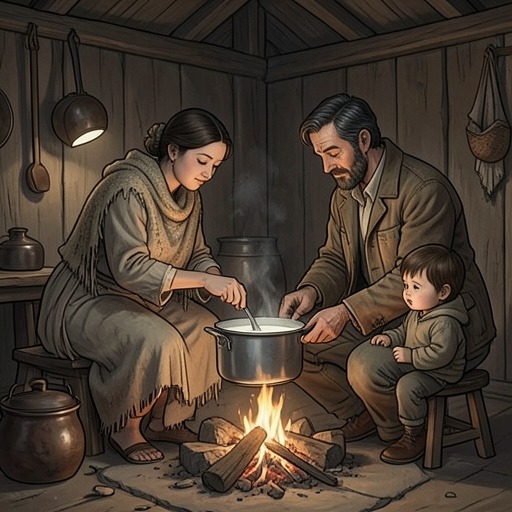
Her attempts to feed the child show that loving possession does not itself meet a child’s needs. She lights the fire, boils water, and tries to make porridge from kasha. The baby first suckles at her finger, then rejects the bitter food. The infant’s persistent hunger turns the woman’s wish into a responsibility that must be answered materially, not just emotionally. When the Poor Woodcutter comes home and demands to know what is crying, she identifies the baby as the joy of her life. Her declaration makes a choice before the household has agreed to it.
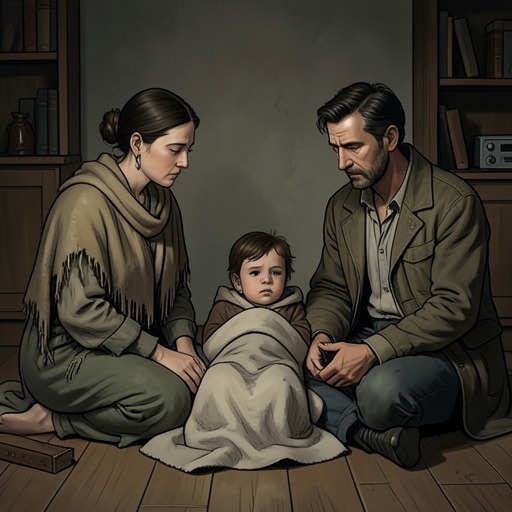
The Poor Woodcutter responds with disgust and racial hostility, dropping the child onto the bed and condemning the child’s origins. The Poor Woodcutter’s Wife immediately takes the baby back into her arms. She tells him that the child is her own little angel and that the child can be his too if he chooses. This offer distinguishes chosen kinship from an attempt to erase the child’s background: she knows the child is Jewish, yet refuses to let that fact justify abandonment. Her husband’s rejection makes adoption a conflict within the marriage as well as an act of compassion. The possibility of family is presented as a decision he must make, not a bond automatically guaranteed by his role as husband.
Care as Work and Shared Responsibility
The Poor Woodcutter’s Wife recognizes that love cannot keep the child alive without milk. She carries the baby, wrapped in the shawl associated with the gods’ gift, into a secluded part of the forest where the Man with the Goat and Shattered Face lives. He is feared by people who know of him, and she approaches his hidden grove uncertain whether he and his nanny goat are there. The journey makes visible the risk and effort attached to care: she takes the child into a place others avoid because she knows that remaining without nourishment is not an option.
She proposes bringing firewood in exchange for milk, and insists that the wood is not his to claim as payment. The arrangement becomes a recurring act of labor: every morning, she brings a bundle of firewood and receives a warm cup of milk. The goat’s milk allows the child to endure, though hunger continues to gnaw at her. The Man with the Goat and Shattered Face explains how to feed the child: for three months, the goat’s milk must be diluted with boiled water, two measures of water to one of milk, and supplemented with porridge, then fruits and vegetables in spring. Care here is exacting and cooperative. The woman supplies wood and carries out the feeding; the man contributes knowledge and milk; the goat provides what the child’s first mother cannot.
When the Poor Woodcutter’s Wife tries to kiss the man’s hand in gratitude, he recoils and tells her to get up. He does not want to be praised as a good man or for others to know that he gives away milk. The exchange is therefore neither charity detached from circumstance nor a simple debt: it rests on a practical arrangement, while the man refuses the posture of superiority that gratitude might impose. His assistance enlarges the child’s family without displacing the woman who has claimed her.
A Wider Family and an Unclaimed Reunion
The arrangement eventually changes the child’s life beyond the daily cup. The Man with the Goat and Shattered Face leads the Poor Woodcutter’s Wife and child into a garden she has never seen, then brings the girl to a goat with swollen udders. He introduces the animal as the child’s wet nurse and third mother. The girl embraces the goat; they press their foreheads together and gaze at one another. The scene gives bodily form to the network of care that has kept the child alive. The goat is not merely a source of milk: the child’s delight and their stillness together make the relationship part of her lived family.
The man explains the exchange in terms of both loss and gain: he gives up the firewood but gains a playmate for his lonely goat, and all four are better off. The change also releases the Poor Woodcutter’s Wife from gathering kindling every day for milk. Care has been redistributed in a way that helps the child, the woman, the man, and the goat, without making their needs identical. The story’s chosen family grows through concrete contributions, each connected to what another member lacks.
Years later, the girl’s birth father recognizes her while she is with the woman who raised her and the goat. He sees that his daughter is alive, happy, and smiling; she gestures toward the goat as the source of the cheeses and welcomes him without knowing who he is. He reaches toward her cheek, but she takes his hand and presses it to her lips before laughing. He withdraws. Rather than disclose himself and unsettle the child’s happiness, he leaves, carrying away the sight of her shared life with her mother. His departure does not undo his earlier effort to save her, but it makes clear that biological fatherhood does not entitle him to interrupt the bonds formed in his absence.
The Significance of Chosen Kinship
The novel presents motherly love as both attachment and sustained response to dependence. The Poor Woodcutter’s Wife’s initial longing becomes a daily undertaking: she holds the hungry baby, searches for food, risks entering the feared grove, and brings wood for milk. The Man with the Goat and Shattered Face and the goat extend that undertaking through knowledge, nourishment, and companionship. None can substitute for every other form of care, and the child’s survival depends on their work joining together.
This family is chosen under conditions shaped by persecution, deprivation, and separation. The baby has been cast from a train carrying deportees; her birth parents’ desperate circumstances and the Poor Woodcutter’s Wife’s childlessness meet in a transfer that saves her but does not erase her origins. At the ending, the birth father’s decision not to reveal himself leaves that complexity intact. The girl has a father who saved her, a mother who raised her, and further maternal care from the goat and the man who made nourishment possible. Kinship is shown not as a single claim of blood or possession, but as a relationship sustained by acts that let the child live and belong.